Laboratory automation refers to the use of technology, instrumentation, robotics, and software to perform laboratory tasks with minimal human intervention, enhancing throughput, accuracy, reproducibility, and safety. It spans sample preparation, analysis, data acquisition, and reporting across disciplines like clinical diagnostics, pharmaceuticals, biotechnology, genomics, chemistry, and environmental testing.
The roots of lab automation trace to the 1950s with early autoanalyzers (Technicon AutoAnalyzer, 1957) for clinical chemistry. The 1980s-1990s saw robotic arms and liquid handlers in drug discovery, while the 2000s genomics boom drove high-throughput systems. As of 2025, the Global Laboratory Automation Market exceeds USD 6-8 billion, growing at 7-10% CAGR due to rising demand for precision medicine, high-throughput screening (HTS), point-of-care testing, and AI integration. Major drivers include labor shortages, error reduction, and regulatory compliance (CLIA, GLP, GMP). Leading vendors: Agilent, Beckman Coulter (Danaher), PerkinElmer, Tecan, Hamilton, Thermo Fisher Scientific, and Siemens Healthineers.
Automation transforms laboratories from manual, error-prone operations to efficient, data-rich environments, enabling 24/7 operation and complex workflows.
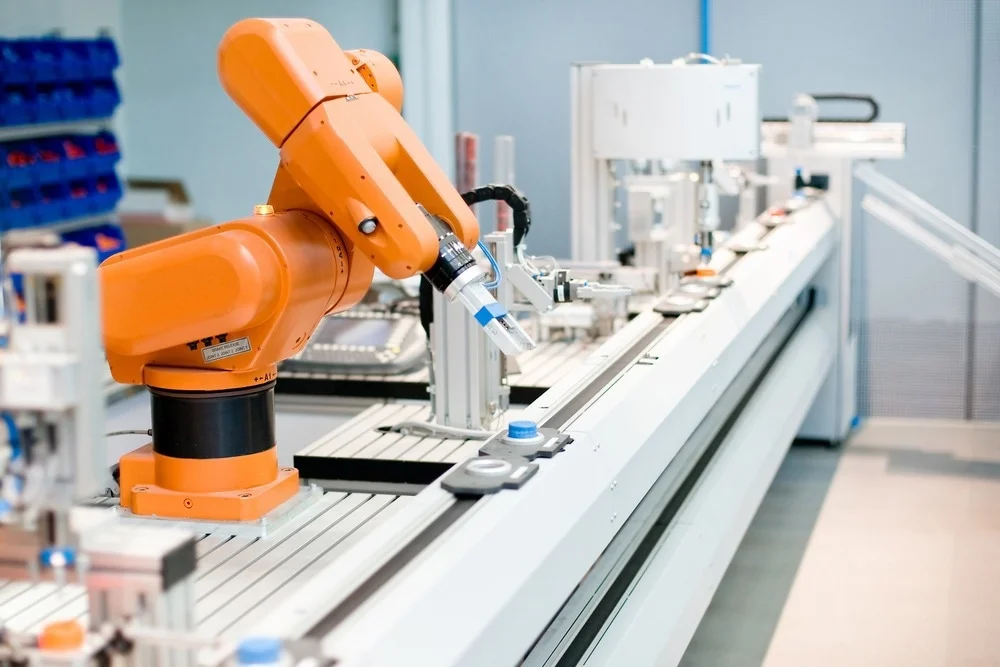
Types of Laboratory Automation Systems
Automation levels range from modular instruments to fully integrated platforms:
- Standalone Automated Instruments
- Autoanalyzers for clinical chemistry/hematology.
- Automated ELISA readers, PCR thermocyclers.
- Liquid Handling Systems
- Pipetting robots (96/384/1536-well formats).
- Acoustic droplet ejection (non-contact).
- Robotic Workstations
- Modular arms for plate movement, capping/decapping.
- Laboratory Information Management Systems (LIMS)
- Software for workflow orchestration, data tracking.
- Total Laboratory Automation (TLA)
- Clinical labs: Conveyor tracks linking pre-analytic, analytic, post-analytic modules (e.g., Roche Cobas, Beckman Power Express).
- High-Throughput Screening (HTS) Platforms
- Drug discovery: Compound libraries, assay readers.
- Next-Generation Sequencing (NGS) Automation
- Library prep robots (Illumina, Thermo).
- Point-of-Care and Microfluidic Automation
- Lab-on-chip devices.
Key Components
- Robotics
- Articulated arms, gantry systems, collaborative robots (cobots).
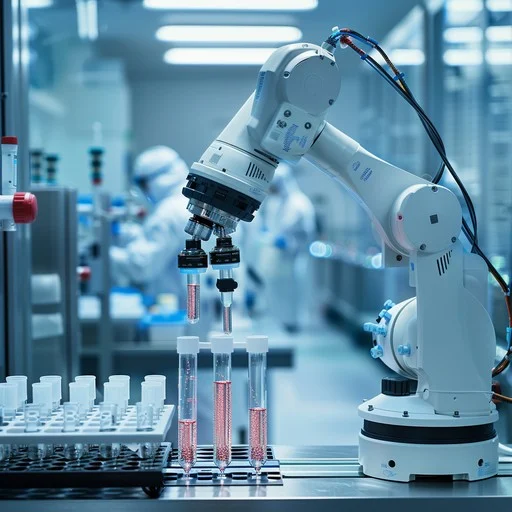
- Liquid Handlers
- Positive displacement, air displacement, peristaltic pumps.
- Readers/Detectors
- Plate readers (absorbance, fluorescence, luminescence), mass spectrometers.
- Software
- Scheduling, protocol design, integration (LIMS, ELN).
- Consumables
- Tips, plates, reagents.
Benefits
- Throughput: 10-100x increase.
- Accuracy/Reproducibility: Reduces human error (<1% CV vs. 5-10% manual).
- Safety: Minimizes exposure to biohazards/chemicals.
- Cost Savings: Long-term (labor, reagent efficiency).
- Data Integrity: Audit trails, compliance.
- Scalability: Handles surges (pandemic testing).
Applications
- Clinical Diagnostics High-volume chemistry, immunology, hematology.
- Drug Discovery HTS for hit identification.
- Genomics/Proteomics NGS library prep, mass spec sample handling.
- Biomanufacturing Cell culture, assay automation.
- Environmental/Food Testing Contaminant screening.
- Research Academic core facilities.
Challenges
- High capital cost.
- Complexity/integration.
- Maintenance/downtime.
- Validation for regulated environments.
- Skill gap for operation/programming.
Market Trends
- AI/ML for predictive maintenance, anomaly detection.
- Modular/flexible systems.
- Cloud-based LIMS.
- Miniaturization/microfluidics.
- Sustainability (energy-efficient robots).
Asia-Pacific fastest growth (biotech hubs).
Future Outlook
By 2030:
- Fully autonomous labs (“lights-out” operation).
- Digital twins for simulation.
- Hyper-throughput (millions samples/day).
- Integration with AI diagnostics.
Conclusion
Laboratory automation has revolutionized scientific workflows, enabling unprecedented scale, precision, and safety. From clinical testing to drug discovery, it accelerates research while reducing errors and costs. As AI, robotics, and miniaturization advance, automation will further democratize high-throughput science, driving breakthroughs in personalized medicine and beyond. Strategic implementation balances investment with workflow needs for maximum impact.
More articles by ZMR Researche:
https://www.zionmarketresearch.com/de/report/b2b-cross-border-payments-market
https://www.zionmarketresearch.com/de/report/molded-fiber-pulp-packaging-market
https://www.zionmarketresearch.com/de/report/lighted-mirror-medicine-cabinets-market
https://www.zionmarketresearch.com/de/report/electric-motorcycle-and-scooter-market
https://www.zionmarketresearch.com/de/report/custom-software-development-services-market