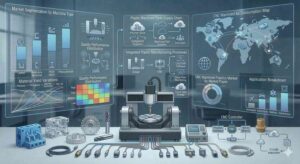
The Digital Backbone of Modern Manufacturing: A Comprehensive Analysis of the Global CNC Machine Tools Market
From the engine in your car to the casing on your smartphone, countless components owe their existence to the precision of Computer Numerical Control (CNC) machine tools. These automated workhorses form the very foundation of modern industry, and as manufacturing embraces digitalization, the market for them is poised for explosive growth. According to a detailed report by Facts & Factors, the global CNC machine tools market is projected to more than double from USD 101.22 billion in 2025 to USD 251.61 billion by 2034, expanding at a robust compound annual growth rate (CAGR) of 11.10%.
This article provides an in-depth analysis of the global CNC machine tools market, exploring its key types, dominant end-user industries, and the trends driving its evolution as the core of smart factories.
What are CNC Machine Tools?
Computer Numerical Control (CNC) machine tools are automated manufacturing equipment that use pre-programmed computer software to dictate the movement of factory tools and machinery. Unlike manual control, CNC allows for complex tasks to be performed with extreme precision, repeatability, and speed. The market encompasses a wide range of subtractive manufacturing technologies:
-
By Type: Dominated by Milling Machines (27.8% share) for their versatility, and Lathe Machines for high-volume cylindrical parts.
-
By Application: Led by the massive Metalworking (over 70% share) segment.
-
By End-User: The Automotive & Transportation (41.9% share) sector is the largest consumer, with Aerospace & Defense as a high-margin second.
Key Market Drivers: Industry 4.0, EVs, and the Need for Precision
The explosive growth of the CNC machine tool market is fueled by the convergence of digital technology and the need for ever-more-complex manufactured parts.
-
The Rise of Industry 4.0 and Smart Manufacturing: This is the single most powerful driver. Manufacturers are racing to create fully connected “smart factories” where machines communicate, adapt, and optimize themselves. Modern CNC systems are now equipped with IIoT sensors and AI-driven analytics, enabling real-time monitoring, predictive maintenance, and data-driven efficiency gains. This shift is making the replacement of older, standalone machines with advanced, connected tools a strategic imperative. The Milling Machines segment’s dominance is partly due to their suitability for integration into these flexible, automated cells.
-
The Electric Vehicle (EV) and Aerospace Revolutions: The global transition to EVs is a massive growth engine. EVs require a new generation of high-precision components—from lightweight battery housings to intricate motor shafts—often made from advanced alloys and composites that demand the capabilities of modern CNC equipment. Simultaneously, the aerospace industry’s focus on new materials (like titanium and Inconel) and complex geometries for turbine blades and structural parts drives demand for high-margin, multi-axis machining centers.
-
Reshoring and Regional Manufacturing Self-Sufficiency: Geopolitical trends are pushing countries and regions to invest in domestic manufacturing capacity. Initiatives like the “CHIPS Act” in the U.S., “Made in China 2025,” and “Make in India” are fueling massive investments in new production facilities, all of which require extensive fleets of CNC machine tools.
Market Segmentation: Milling Machines and Automotive Lead
The market segmentation clearly illustrates the dominance of versatile machining technologies and the sheer volume of the automotive sector.
By Type: The Versatility of Milling Machines
-
Milling Machines (27.8% Market Share): This segment’s leadership is due to their unparalleled operational flexibility. They can perform a vast range of cutting, drilling, and shaping tasks on prismatic parts (blocks with flat surfaces) used across every industry, from engine blocks to electronic housings.
-
Lathe Machines (24% Share): The second-largest segment, indispensable for producing the millions of symmetrical, cylindrical components required annually by the automotive and general machinery sectors—shafts, axles, pistons, and bearings.
By End-User: The Primacy of Automotive & Transportation
-
Automotive & Transportation (41.9% Market Share): This segment is the engine of the market. It demands the highest volume of high-precision parts for mass production, from traditional engine and transmission components to the new structural parts for EVs. The need for both high-speed production lines and extreme accuracy makes it the dominant consumer.
-
Aerospace & Defense (18% Share): The second-largest and highest-margin segment. It requires the most advanced 5-axis and multi-axis machines capable of processing exotic, difficult-to-machine alloys (like titanium and Inconel) for critical, safety-rated components like turbine blades and landing gear parts.
Regional Landscape: Asia Pacific as the Global Workshop
-
Asia Pacific (55.7% Market Share): The region is the undisputed global leader, serving as both the world’s largest consumer and producer of machine tools. China dominates, driven by its massive industrial base and government initiatives to move its manufacturing up the value chain. Japan is a critical powerhouse, home to many of the world’s most innovative machine tool builders (like DMG MORI, Mazak, and Okuma). India is emerging as a major growth engine, fueled by the “Make in India” campaign.
-
North America: A major market experiencing a resurgence due to “reshoring.” Companies are bringing manufacturing back to the U.S. and Mexico to secure supply chains, a transition heavily dependent on automation and advanced CNC machinery. The EV boom and a robust aerospace sector are also key drivers.
-
Europe: A key center for precision engineering, with Germany leading in Industry 4.0 integration and high-end specialized machinery. The market is characterized by a focus on sustainability and producing sophisticated tools for the luxury automotive and medical technology sectors.
Challenges in the Market
Despite its explosive growth, the market navigates significant hurdles.
-
Acute Shortage of Skilled Labor: This is perhaps the most critical challenge. Modern CNC machines require operators and programmers proficient not just in machining, but in G-code programming, CAD/CAM software, and data analytics. The retiring of experienced machinists and the lack of young talent entering the field creates a massive skills gap that limits how effectively companies can utilize advanced equipment.
-
High Initial Capital Expenditure (CapEx): Acquiring advanced CNC machinery, especially multi-axis machining centers or laser systems, requires a massive financial outlay—often hundreds of thousands or even millions of dollars. This high barrier to entry can be prohibitive for small and medium-sized enterprises (SMEs).
-
Complex Maintenance and High Total Cost of Ownership (TCO): These sophisticated machines require expensive, specialized maintenance. Unplanned downtime can be catastrophic for high-volume production lines, adding to the pressure and cost for manufacturers.
Future Opportunities: AI, Automation, and Sustainable Machining
The future of the CNC machine tools market lies in greater autonomy, intelligence, and sustainability.
-
AI-Powered Programming and Operation: The integration of AI is a game-changer. AI-powered CAM software, like the solution launched by CloudNC in 2025, can automate up to 80% of CNC programming, drastically reducing setup times and helping to alleviate the skilled labor shortage. AI can also be used for real-time toolpath optimization, reducing wear and improving surface finish.
-
Hybrid Machines (Additive + Subtractive): The emergence of machines that combine 3D printing (additive manufacturing) with traditional CNC machining (subtractive) is a major trend. This allows for the creation of near-net-shape parts that are then finished to high precision, offering new design and material efficiency possibilities.
-
Sustainable and “Green” Machining: As manufacturers face pressure to reduce their environmental footprint, there is a growing opportunity for machine tools that are more energy-efficient, use less coolant, and generate less waste. DMG MORI’s 2026 launch of its “Ecoline” machines, which focused on extreme energy efficiency, is a prime example of this trend.
Competitive Landscape
The global CNC machine tools market is dominated by a few large, global players, primarily based in Japan, Germany, and the U.S. Key companies include DMG MORI CO., LTD., Yamazaki Mazak Corporation, FANUC Corporation, Okuma Corporation, and Haas Automation, Inc. These firms compete on precision, reliability, automation integration, and global service networks. The market is also seeing increasing competition from high-quality Chinese manufacturers.
For the full report, detailed data tables, and additional insights, visit: https://www.fnfresearch.com/cnc-machine-tools-market
In conclusion, the global CNC machine tools market is on a powerful growth path, serving as the digital backbone for the factories of the future. By embracing AI, automation, and sustainable practices, this industry will continue to be the essential enabler of modern manufacturing, from the smallest medical implant to the largest aerospace component.