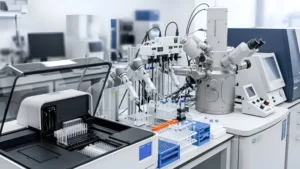
Pharmaceutical Quality Control (QC) is the set of procedures, tests, and systems implemented to ensure that drug products consistently meet predefined standards for identity, strength, quality, purity, safety, and efficacy. QC forms a critical component of Good Manufacturing Practices (GMP) and is essential for patient safety, regulatory compliance, and product reliability.
The foundations of modern pharmaceutical QC emerged in the early 20th century with the establishment of pharmacopeial standards (e.g., USP in 1820, BP in 1864). Major milestones include the 1906 U.S. Pure Food and Drug Act, the 1938 Federal Food, Drug, and Cosmetic Act following tragedies like the sulfanilamide elixir disaster, and the 1962 Kefauver-Harris Amendments requiring proof of efficacy. Today, QC is governed by harmonized guidelines such as ICH (International Council for Harmonisation), FDA 21 CFR Parts 210/211, EU GMP Annex 1, and WHO standards. The global pharmaceutical QC market, encompassing testing services, instruments, and software, exceeds USD 10-15 billion annually as of 2025, driven by complex biologics, personalized medicines, and stringent regulatory scrutiny.

Principles and Objectives
QC operates on the principle that quality cannot be tested into products but must be built in through robust design and control (Quality by Design – QbD, ICH Q8-Q10). Key objectives:
- Ensure batch-to-batch consistency.
- Detect deviations, impurities, or contamination.
- Verify compliance with specifications.
- Protect patients from substandard or adulterated drugs.
QC complements Quality Assurance (QA), which focuses on preventive systems, while QC emphasizes verification through testing.
Key Components of Pharmaceutical QC
- Raw Material and In-Process Testing Incoming APIs, excipients, and packaging materials undergo identity, purity, and potency tests (e.g., FTIR, HPLC, Karl Fischer for moisture).
- Finished Product Testing
- Physical: Appearance, weight variation, hardness, friability (tablets), viscosity (liquids).
- Chemical: Assay (potency), impurity profiling, dissolution (critical for bioavailability).
- Microbiological: Sterility (injectables), microbial limits, endotoxin testing (LAL assay).
- Stability Testing Long-term, accelerated, and stress studies (ICH Q1A) monitor degradation under temperature, humidity, light, and oxidation.
- Environmental Monitoring Cleanroom particulate/viable counts, pressure differentials.
- Packaging and Labeling Control Integrity tests, child-resistant compliance.
Analytical Techniques in QC
Modern QC relies on sophisticated instrumentation:
- Chromatography: HPLC/UHPLC (assay, impurities), GC (residual solvents), IC (ions).
- Spectroscopy: UV-Vis (content uniformity), FTIR/NIR (identity), NMR/MS (structure confirmation).
- Dissolution/Disintegration: Apparatus for release profiling.
- Particle Size Analysis: Laser diffraction, sieving.
- Karl Fischer Titration: Water content.
- Mass Spectrometry: Impurity identification, proteomics for biologics.
Process Analytical Technology (PAT, ICH Q8) integrates real-time monitoring (NIR, Raman) for continuous manufacturing.

Regulatory Framework and Standards
- FDA: 21 CFR 211 mandates QC units independent of production.
- EMA: EU GMP Part I/II.
- ICH Guidelines: Q1 (stability), Q2 (validation), Q3 (impurities), Q6 (specifications), Q9 (risk management), Q10 (pharmaceutical quality system).
- Pharmacopeias: USP, EP, JP set monographs and general chapters.
- Data Integrity: ALCOA+ principles (Attributable, Legible, Contemporaneous, Original, Accurate) enforced post-2010s scandals.
Out-of-specification (OOS) investigations follow FDA guidance.
Challenges in Pharmaceutical QC
- Complex Molecules: Biologics require bioassays, glycan analysis, higher-order structure assessment.
- Nitrosamine Impurities: Post-2018 recalls drove enhanced risk assessments.
- Supply Chain: Counterfeit/raw material variability.
- Rapid Release: Balancing speed (e.g., pandemic vaccines) with thorough testing.
- Global Harmonization: Differing regional requirements.
Emerging Trends
- Automation and Robotics: High-throughput testing, reduced human error.
- AI/Machine Learning: Predictive stability, anomaly detection.
- Continuous Manufacturing: Real-time release testing (RTRT).
- Green Analytics: Reduced solvent use, microscale methods.
- Advanced Therapies: Cell/gene products require potency matrices, viral safety assays.
Role of QC in Patient Safety
Robust QC prevents tragedies like contaminated heparin (2008) or valsartan nitrosamines (2018). It ensures therapeutic equivalence, especially for generics (bioequivalence studies).
Conclusion
Pharmaceutical quality control is the guardian of drug quality, evolving from basic compendial testing to sophisticated, risk-based systems integrating advanced analytics and real-time monitoring. As medicines grow more complex—from small molecules to biologics and personalized therapies—QC adapts through innovation, harmonization, and digital transformation. Ultimately, effective QC underpins public trust in pharmaceuticals, ensuring every dose meets the highest standards of safety and efficacy.
More articles by ZMR Researche:
https://www.zionmarketresearch.com/de/report/agave-nectar-market
https://www.zionmarketresearch.com/de/report/foliar-fertilizer-market
https://www.zionmarketresearch.com/de/report/electric-and-diesel-tractor-market
https://www.zionmarketresearch.com/de/report/primary-macronutrients-market
https://www.zionmarketresearch.com/de/report/badminton-equipment-and-facilities-market